
Camino Portugués: 241 km from Porto to Santiago in 10 stages
The Camino Portugués starts in Portugal and ends in Spain. From Porto, the Central route runs north for about 241 km in 10 stages. It crosses the Minho river from Valença into Tui, then goes through Galicia to the cathedral of Santiago de Compostela. It is the second busiest Camino after the Francés, with about 101,000 Compostelas on the Central route in 2025 and about 90,000 on the Coastal route. The walking is low and gentle, with one real climb, up to about 400 m, but some stages are long and the first one is mostly on asphalt. You also cross a border and a time zone on the way. Here is what to expect, from albergue prices on both sides of the river to the Compostela rules for walkers who start in Portugal.
- High point
- 400 m · Alto da Portela Grande (Labruja)
- Duration
- 10–13 days
- Best months
- May–Sep
- Difficulty
- Moderate, non-technical
- Guide
- Not required
For guidance only. Check details with your operator and the official sources listed at the end before you book.
Where to book and compare Camino Portugués trips
Booking sites · affiliate linksEach site lists trips from several operators. Compare dates, group sizes, what is included and reviews there; we don't rank operators.
We earn a commission if you book through these links, at no extra cost to you. Prices and availability are on each site.
On this page
Which route should you choose?
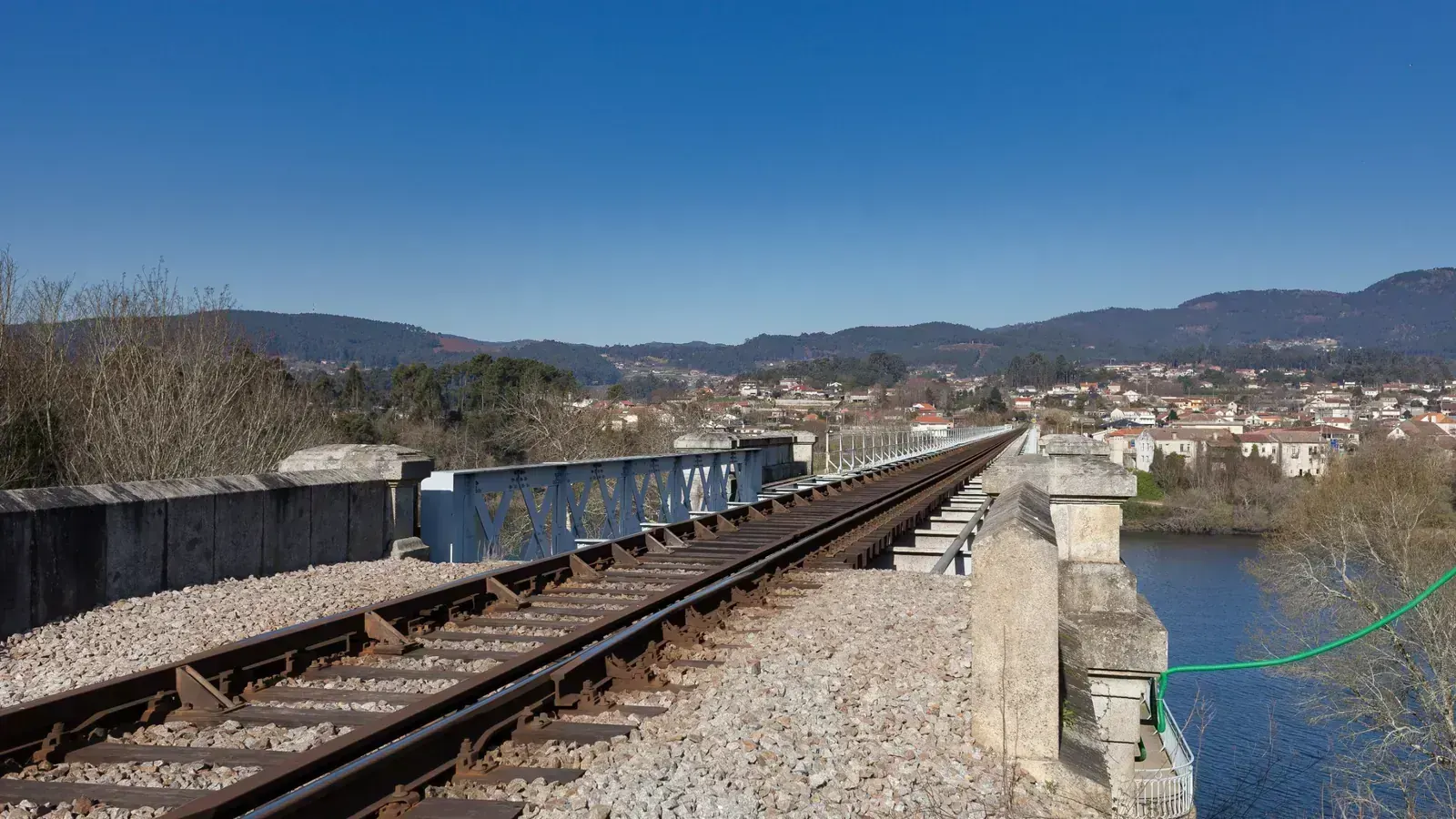
The Camino Portugués begins in Portugal and finishes in Spain. The page sits with our Spain treks because its end, the Compostela and most of the official rules are Spanish, but the first half of the walk is Portuguese. The two countries meet at the river Minho, between Valença and Tui, on a metal road and rail bridge from 1886. Spain is one hour ahead of Portugal, so put your watch forward on the bridge.
From Porto there are two main lines. The Central route goes inland through farmland, small towns and woods, about 241 km to Santiago. The Coastal route follows the Atlantic for about 187 km and joins the Central route at Redondela, about 271 km in all. Many walkers start in Tui instead, about 116 km from Santiago. The full route from Lisbon is about 608 km, with 15 more stages before Porto. From Pontevedra, the Variante Espiritual is another way to Padrón, via A Armenteira and Vilanova de Arousa, about 79 km instead of 40 km.
For the Compostela you must walk at least the last 100 km, and walkers who start outside Spain must walk at least 70 km inside Spain. From Porto, Tui is already 116 km from Santiago, so both rules are met.
| Route | Days | Scenery | Crowds | Acclimatisation |
|---|---|---|---|---|
| Central route from Porto to Santiago itinerary belowAbout 241 km in 10 stages, through Barcelos, Ponte de Lima, Valença and Tui, then Redondela, Pontevedra and Padrón. Two stages are over 30 km; splitting them adds two days. Porto was the starting point for about 51,580 Compostelas in 2025. | 10–12 | Very good | Medium | Very good |
| Coastal route from Porto, joining the Central route at RedondelaAbout 271 km in 13 stages along the Atlantic, via Póvoa de Varzim, Viana do Castelo, Caminha, A Guarda, Baiona and Vigo, then the Central route from Redondela. The river Minho is crossed by boat from Caminha to A Guarda; check that the boat is running, and its times, before you go. The number of Compostelas on this route grew by about 20% in 2025. In Vigo, the route had no official waymarking in October 2025, so many walkers use a GPS track there. | 13 | Excellent | High | Very good |
| Tui to Santiago, the last stretch from the borderAbout 116 km in 5 stages, the usual shortest start in Spain on the Central route for the Compostela. Tui was the starting point for about 41,645 Compostelas in 2025, so beds and paths are busy. Correos Paq Mochila runs here all year. | 5 | Very good | High | Very good |
10-day Central route from Porto to Santiago itinerary at a glance
The itinerary below follows the Central route in the 10 stages that the gronze.com stage guide uses. Day 1 leaves Porto through suburbs and an industrial estate, practically all on asphalt, about 27 km; the gronze.com guide says there is no need to skip it by taking the metro. Day 3, Barcelos to Ponte de Lima, is the longest at about 35 km. Day 4 is short, about 17 km, and holds the only real climb: about 4 km up through woods, past the Cruz dos Franceses (325 m), to the Alto da Portela Grande (400 m).
Day 5 crosses the Minho into Tui, about 19 km, on a footway kept apart from the traffic. You lose an hour at the border, which matters if you want a bed in a Galician public albergue: they open at 13:00 Spanish time. Day 6, Tui to Redondela, is about 32 km; some stage guides break it at O Porriño, about 19 km from Tui. The last four days, via Pontevedra, Caldas de Reis and Padrón, are 19 km to 24 km each.
From Tui on, you are in the last 100 km: collect two dated stamps a day, at the start and end of each stage. In Galicia, granite milestones show the kilometres left to Santiago.
- Day 1 Porto Vilarinho night at 60 m
- Day 2 Barcelos
- Day 3 Ponte de Lima night at 15 m
- Day 4 Rubiães via Alto da Portela Grande (Labruja) 400 m
- Day 5 Tui night at 55 m
- Day 6 Redondela night at 17 m
- Day 7 Pontevedra night at 27 m
- Day 8 Caldas de Reis night at 24 m
- Day 9 Padrón night at 5 m
- Day 10 Santiago de Compostela night at 260 m
What it really costs
No permit is needed, only a credencial. The main costs are beds and food, and they differ between Portugal and Galicia. Prices below are 2026 figures and change often.
Insurance that covers Camino Portugués
Unless you hold a European health card (EHIC), take travel insurance with medical cover for both Portugal and Spain, for the whole trip. Check that it covers long-distance walking. In an emergency call 112, which works in both countries. In Spain, 062 reaches the Guardia Civil, and the AlertCops app from the Spanish Interior Ministry has an SOS button and location sharing.
Staying connected in Spain
If you buy a SIM or eSIM in Spain, you need your passport to register it. Download an offline map and the GPS track of your route before you set off, especially if you take the Coastal route through Vigo.
Getting there and where to stay
Fly into Porto (OPO) to start the full route, or reach Tui for the shorter one. At the end, Santiago has its own airport and a high-speed train to Madrid.
Getting there by air
Porto airport, Porto to Tui, and Santiago
A night in Porto before you start
Gear: rent or buy
This is a low-level walk on asphalt, town streets, tracks and woodland paths. Summer days are mild: about 24 °C to 26 °C at their warmest in Porto and Pontevedra. From October to May, rain is frequent, so pack for wet days.
- Walking shoes or light boots, broken in before you go (long stages on hard surfaces)Buy
- Rain jacket and a pack coverBuy
- Light backpack, or a daypack if a luggage service carries your bagRent or buy
- Light sleeping bag or liner for albergue dormsBuy
- Earplugs and an eye mask for shared dormsBuy
- Sun hat, sunglasses and sunscreenBuy
- Trekking poles for the Labruja climb and descentRent or buy
- Credencial, bought at the startBuy
- Refillable water bottle, and anything you need for your religious practice, such as a qibla app or a light prayer matBuy
- Bank card and some cash, offline map, first-aid kit and power bankBuy
Add a few days in Spain
A few things fit around the walk, on the way or after you arrive.
The Valença–Tui International Bridge
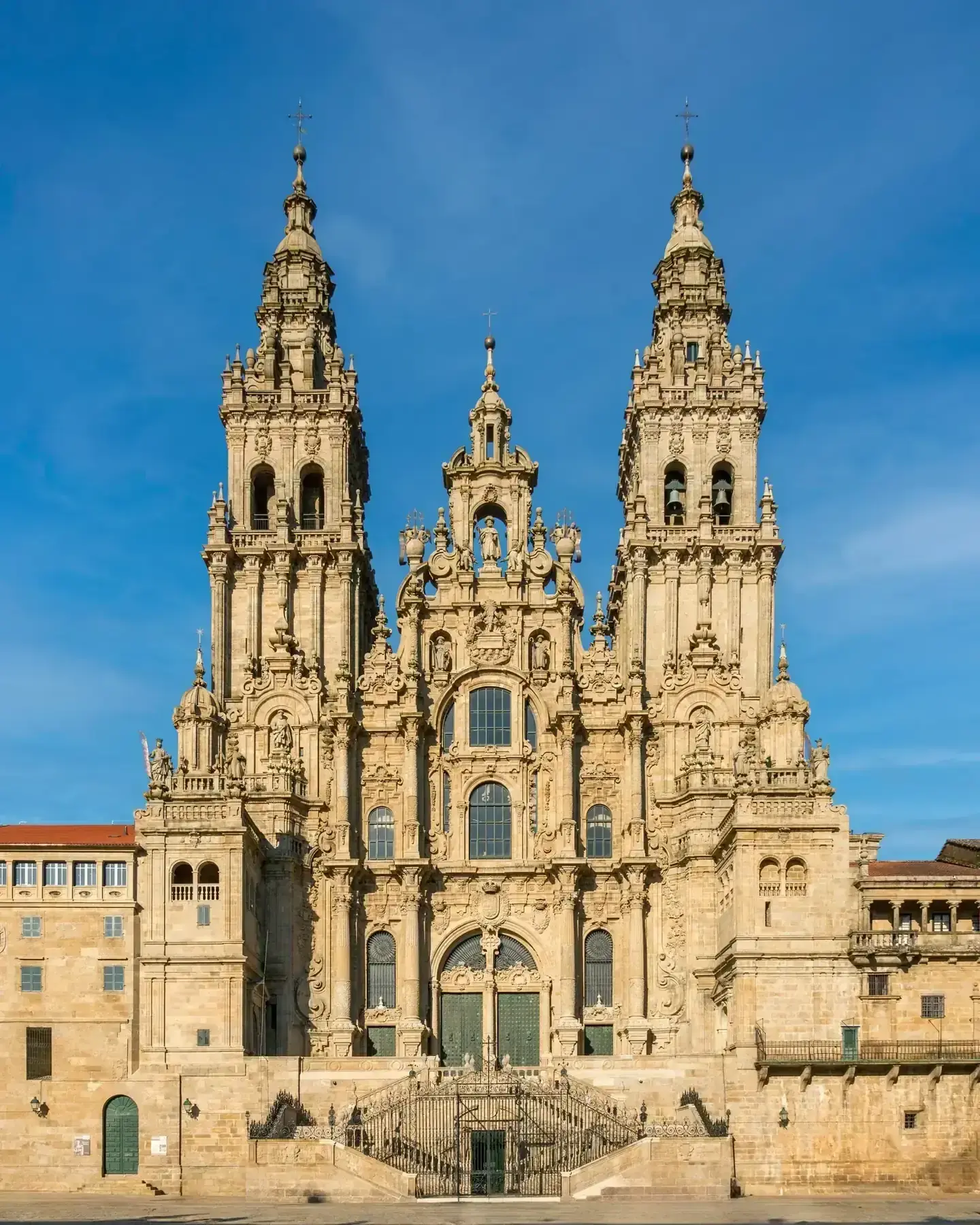
Santiago Cathedral
On to Fisterra and Muxía
Frequently asked questions
How hard is the Camino Portugués?
Moderate. The route stays low, with one climb on day 4 up to about 400 m, but three of the five stages in Portugal are 26 km to 35 km long. The first stage out of Porto is mostly asphalt, which is hard on the feet. Splitting the two longest stages makes the walk easier.
Do I need a permit or a guide?
No. There is no permit and no guide is needed; the route is waymarked with yellow arrows and scallop shells. You do need a credencial, the pilgrim passport, to sleep in pilgrim albergues and to claim the Compostela.
How do I get the Compostela?
Walk at least the last 100 km to the cathedral, on one route, and get two dated stamps a day in that stretch. If you start in Portugal, at least 70 km must be inside Spain; from Porto or Valença you walk about 116 km in Spain. The Compostela is free and is given for religious and/or spiritual motives; anyone can ask for the certificate of distance (€3). The Pilgrim's Office is at Rúa Carretas 33, open daily 10:00 to 19:00 (closed 25 December and 1 January). Register online and take a QR ticket; in busy periods you may not get it the same day.
Where do I sleep, and do I need to book?
In pilgrim albergues, private albergues, pensions and hotels. Galician public albergues cannot be booked; Portuguese albergues and private places set their own rules. In summer, albergues in Redondela and Pontevedra, and in Baiona and Vigo on the Coastal route, can fill quickly. In the 2027 Holy Year, book private beds earlier. Note that the Rubiães albergue is closed from 15 November 2026 to 31 January 2027.
What about food, dietary needs and faith on the Camino?
No albergue states halal food. Pork is common in Galician food: chorizo, ham, lacón, and caldo gallego is traditionally made with pork fat, so check before you order if you avoid pork or eat vegetarian. Fish, octopus, eggs, vegetables, bread and cheese are easy to find. Ask "sin cerdo" (no pork), whether broths or beans contain pork or chorizo, and whether wine is used. Vegan and kosher food is not something to expect in albergues and cafés: bring what you need, and explain any allergy clearly when you order.
If you pray during the day, a qibla app helps on the trail. There are mosques in Vigo (Centro Cultural Islámico Al Firdaous) and Santiago (Comunidad Islámica de Galicia, Rúa Penedo 1); the Porto mosque was due to leave its building by 31 October 2026, so check its current address.
Which languages do guides speak?
In albergues and restaurants you will hear Portuguese, Spanish and some English. If you book a package through an operator, ask before you book about support in other languages, such as Arabic or French.
Should I tip?
In Spain, tipping is not expected; leaving small change or rounding up is welcome for good service.
Which visa do I need?
It depends on your passport: check the Schengen rules for your nationality with the Portuguese or Spanish consulate where you live. Some passports need no visa for stays of up to 90 days in any 180; others need a Schengen visa (€90 for adults in 2026), which covers both Portugal and Spain. Among Gulf passports, for example, UAE citizens need no visa, while Saudi, Qatari, Kuwaiti, Bahraini and Omani citizens do; they can get a five-year multiple-entry visa on their first application, and in October 2026 the EU began a review of visa-free travel for these five countries, but nothing has changed yet. The EU Entry/Exit System has taken fingerprints and a photo on first entry since 10 April 2026; ETIAS is not running yet.
When is the best time to go?
May to September, when rain is lowest and days are mild. September 2025 was the busiest month on the Camino overall. From October to January rain is heavy. In 2027, a Holy Year, expect more pilgrims, especially in Holy Week (21 to 28 March) and in mid-to-late July.
Is it safe?
Much of the first stage out of Porto is on asphalt through suburbs, so take care on road stretches. On the Minho bridge, the footway is separated from the traffic. In Vigo, on the Coastal route, waymarking was unofficial in October 2025, so carry a GPS track. In an emergency call 112 in Portugal or Spain.
Does the time change at the border matter?
Yes. Spain is one hour ahead of Portugal, so you lose an hour when you cross from Valença into Tui. Galician public albergues open at 13:00 Spanish time and take walkers in order of arrival, and train and bus times on each side follow local time.
Sources and last check
- Gronze: Camino Portugués stages and distances, Lisbon, Porto, Tui and Variante Espiritual (checked 6 Nov 2026)
- Gronze: Camino Portugués por la Costa stages and distances (checked 6 Nov 2026)
- Gronze: Porto–Vilarinho stage, asphalt and Porto albergue prices (checked 6 Nov 2026)
- Gronze: Ponte de Lima–Rubiães stage, albergue prices and Rubiães closure (checked 6 Nov 2026)
- Gronze: Rubiães–Tui stage, bridge footway and albergue prices (checked 6 Nov 2026)
- Correos: Ponte de Lima–Rubiães stage, Alto da Portela 400 m (checked 6 Nov 2026)
- Viaje Camino de Santiago: highest points of the Camino, Serra da Labruja (checked 6 Nov 2026)
- Viaje Camino de Santiago: Porto–Santiago stages, Tui–O Porriño split (checked 6 Nov 2026)
- Wikipedia (es): Tui, altitude (checked 6 Nov 2026)
- Wikipedia (es): Redondela, altitude (checked 6 Nov 2026)
- Wikipedia (es): Padrón, altitude (checked 6 Nov 2026)
- Wikipedia (es): Spanish provincial capitals by altitude, Pontevedra (checked 6 Nov 2026)
- Wise Pilgrim: Vilarinho on the Camino Portugués, altitude (checked 6 Nov 2026)
- Wise Pilgrim: Ponte de Lima, altitude (checked 6 Nov 2026)
- Hispanopedia (es.wikipedia mirror): Caldas de Reyes, altitude (checked 6 Nov 2026)
- Wikipedia: Santiago de Compostela, altitude (checked 6 Nov 2026)
- Pilgrim's Office: the Compostela, 100 km and 70 km rules, stamps, opening hours (checked 6 Nov 2026)
- Pilgrim's Office: where to get the credencial, office address (checked 6 Nov 2026)
- Pilgrim's Office: certificate of distance (checked 6 Nov 2026)
- Turismo Rías Baixas: Tui International Bridge (checked 6 Nov 2026)
- Seat61: Porto–Vigo Celta train, fares, time difference and 2026–2027 bus replacement (checked 6 Nov 2026)
- CP: Celta train Porto–Vigo, daily service and seat reservation (checked 6 Nov 2026)
- Dica de Portugal: Porto airport to the city by metro (August 2026)
- Wego: flights from the UAE to Portugal, no nonstop to Porto (April 2026)
- Que.es: Qatar Airways summer 2026 routes to Spain and Lisbon (21 June 2026)
- Wego: flights from the UAE to Spain, Emirates and Etihad to Madrid (2026)
- Kombo: Madrid–Santiago train times (checked 6 Nov 2026)
- CaminoWays: Santiago airport closure 23 April–27 May 2026 (updated 26 Oct 2026)
- Albergues Camino Santiago: price of Galicia's public albergues (September 2025, updated November 2025)
- Albergues Camino Santiago: Xunta public albergue network rules (October 2024, updated June 2025)
- Albergues Camino Santiago: Coastal route record and Vigo waymarking (October 2025)
- Albergues Camino Santiago: Xacobeo 2027 dates and Holy Door (updated 30 Oct 2026)
- Albergues Camino Santiago: Guardia Civil advice, 112, 062 and AlertCops (September 2025)
- Albergues Camino Santiago: Pilgrim Mass and cathedral visits, backpacks (reviewed 30 Oct 2026)
- Viaje Camino de Santiago: Camino statistics 2025 by route and start point (checked 6 Nov 2026)
- American Pilgrims on the Camino: 2025 statistics and growth by route (checked 6 Nov 2026)
- Viaje Camino de Santiago: Camino costs in 2026, private albergues, pensions, daily budget (12 July 2026)
- Viaje Camino de Santiago: the Compostela and where credenciales are sold (18 June 2026)
- Felices Vacaciones: price of the pilgrim menu (undated)
- IPC: Correos Paq Mochila 2026 season, new Portuguese Way service (13 March 2026)
- Correos: Paq Mochila conditions (checked 6 Nov 2026)
- Correos: Paq Mochila FAQ, seasons and Tui–Santiago all year (12 March 2026)
- Correos: Xacobeo 2027 Holy Year (checked 6 Nov 2026)
- Observador: Porto mosque must leave its building by October 2026 (29 May 2026)
- Páxinas Galegas: Centro Cultural Islámico Vigo Al Firdaous (checked 6 Nov 2026)
- Páxinas Galegas: Islamic communities in Santiago de Compostela (checked 6 Nov 2026)
- IPMA: Porto Pedras Rubras climate normals 1991–2020 (checked 6 Nov 2026)
- AEMET: Pontevedra climate normals (checked 6 Nov 2026)
- AEMET: Santiago airport climate normals 1981–2010 (checked 6 Nov 2026)
- La Presse: EU review of visa-free travel for five GCC countries (22 Oct 2026)
- The National: five-year Schengen visas for GCC citizens (May 2024)
- Embassy of Poland in Kuwait: Schengen visa fee from 11 June 2024
- Newland Chase: EES in force, ETIAS not yet running (9 Sep 2026)
- Selectra: SIM registration with a passport in Spain (updated 3 Nov 2026)
- Xunta de Galicia: km 100 milestone with yellow arrow and shell (February 2022)