
Alta Via 1 in the Dolomites: Lago di Braies to Belluno, hut to hut
The Alta Via 1 is the classic north-to-south high route of the Dolomites, about 125 km from Lago di Braies in South Tyrol to Belluno in the Veneto. The official line has twelve stages from hut to hut, and hikers take 8–13 days on it. It tops out at Rifugio Lagazuoi, at 2,752 m, and is often called the easiest of the classic Dolomites high routes: mostly marked paths, no full via ferrata on the main line, but long climbs and descents every day. Huts are open roughly from late June to mid-September, and the northern ones fill months ahead for July and August. Here is what to expect, stage by stage, from the lake to the long last descent.

- High point
- 2,752 m · Rifugio Lagazuoi, on the summit of Piccolo Lagazuoi
- Duration
- 8–13 days
- Best months
- Jun–Sep
- Difficulty
- Moderate, non-technical
- Guide
- Not required
For guidance only. Check details with your operator and the official sources listed at the end before you book.
Where to book and compare Alta Via 1 trips
Booking sites · affiliate linksEach site lists trips from several operators. Compare dates, group sizes, what is included and reviews there; we don't rank operators.
We earn a commission if you book through these links, at no extra cost to you. Prices and availability are on each site.
On this page
Which route should you choose?
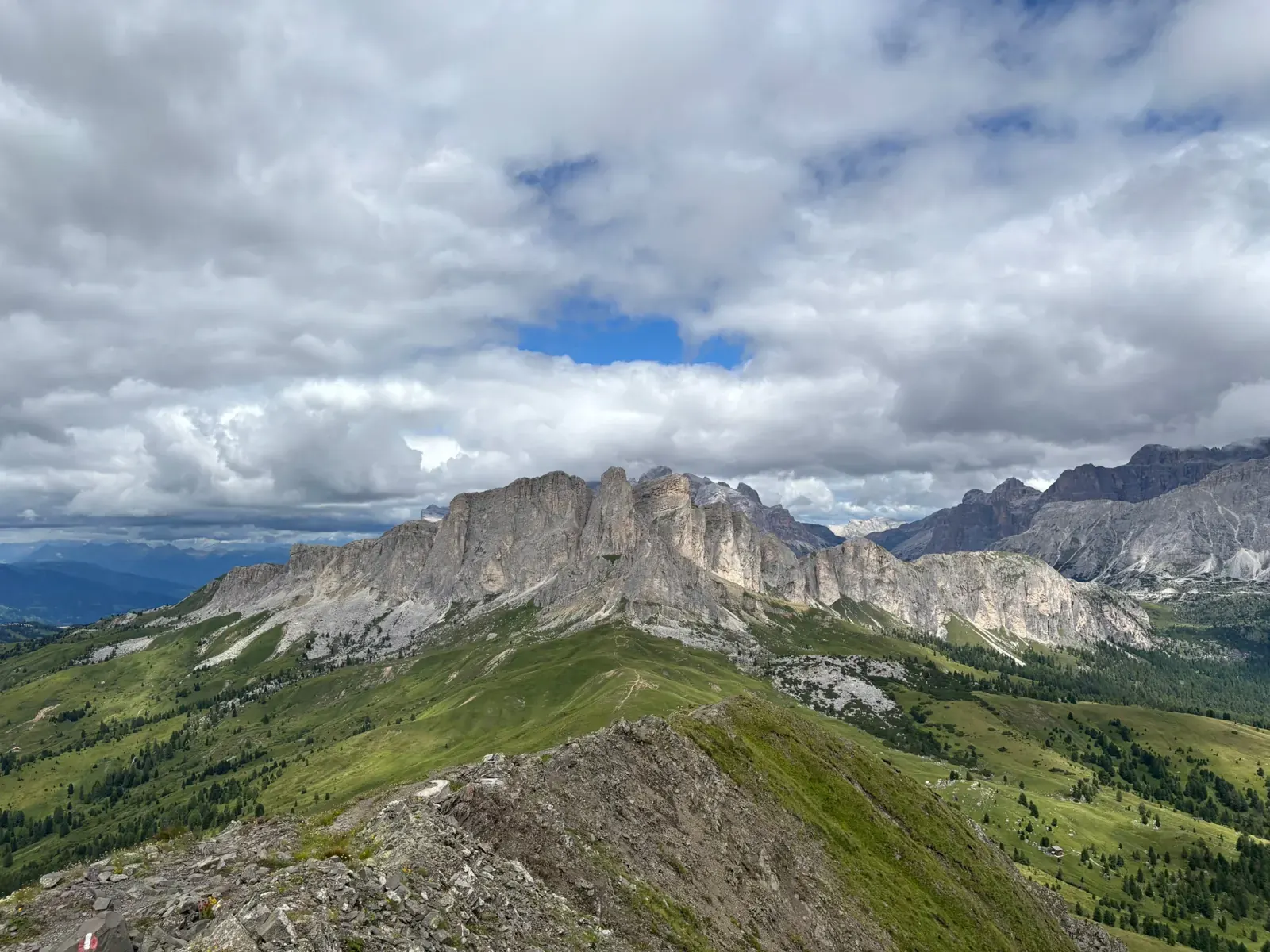
The Alta Via 1 runs south from Lago di Braies (1,494 m) to Belluno (389 m), waymarked with a blue triangle and the number 1. The official route page gives about 125 km, with about 7,300 m of ascent and 8,400 m of descent; adding up the stage figures gives closer to 130 km. The biggest climb is from Fanes to Lagazuoi, about 1,070 m, and the biggest descent is the last day, about 1,900 m down to Belluno.
Most stages are graded E or EE: hiking paths, some steep and rocky. The main line has no full via ferrata, but the descent from Nuvolau to Passo Giau on stage 5 has a ladder and fixed ropes, and the tourist board advises a ferrata kit there; ask the hut about the way round it. Optional equipped variants are the restored First World War tunnel below Lagazuoi, the Castelletto tunnel on the Tofana and the Schiara via ferrata on stage 11, each with a path that avoids it. Passo Falzarego, Cortina, Passo Duran and La Pissa are the natural places to join or leave the route.
| Route | Days | Scenery | Crowds | Acclimatisation |
|---|---|---|---|---|
| The full route: Lago di Braies to Belluno, twelve stages itinerary belowThe official line of about 125 km to 130 km, with about 7,300 m of ascent and 8,400 m of descent. The official route page puts the average at 12–13 days; fit hikers merge a few short stages. The Schiara via ferrata on stage 11 is optional: a longer path avoids it. | 11–13 | Excellent | Medium | Very good |
| Northern half: Lago di Braies to Passo Falzarego or CortinaThe busiest part of the route: Biella, the Fanes plateau and the night at Lagazuoi. From Lagazuoi a cable car drops to Passo Falzarego, with summer buses to Cortina. Often sold as a 4–6 days trip, sometimes with hotel nights in Cortina. The huts here are the first to sell out. | 4–6 | Excellent | High | Very good |
| Shorter full traverse: eight walking days to La PissaLonger days that merge stages, and a finish from Rifugio Pian de Fontana down to the La Pissa bus stop on the Agordo–Belluno road, skipping the Schiara and the last descent. About 116 km. The official route page also says the route can be done in 8–9 days if some passages are skipped. Check the bus from La Pissa to Belluno locally. | 8–9 | Excellent | Medium | Good |
12-day The full route: Lago di Braies to Belluno, twelve stages itinerary at a glance
The itinerary below follows the twelve official stages. Day 1 climbs from the lake to Biella, about 900 m up. Day 2 crosses the Sennes plateau, drops steeply to Pederü (1,548 m) and climbs to the Fanes huts. Day 3 is the big one: over Passo di Limo and Forcella del Lago to the hut on the Lagazuoi summit. Day 4 crosses Forcella Col dei Bos and Passo Falzarego, passes the Cinque Torri and climbs to Nuvolau. Day 5 goes via Passo Giau and Croda da Lago; Day 6 passes below Monte Pelmo.
Days 7 to 10 cross the quieter southern half: the Civetta wall above Lago Coldai, the Moiazza, Passo Duran and the high, rocky Van de Città. Day 11 links Pian de Fontana and 7° Alpini, either by the Schiara via ferrata or by a longer path of about 13 km and 8 hours via Forcella Pis Pilon, without ferrata. Day 12 is the long descent past Case Bortot to Belluno. Many hikers instead finish from Pian de Fontana at the La Pissa bus stop, at about 448 m.

- Day 1 Lago di Braies Rifugio Biella (Seekofelhütte) night at 2,327 m
- Day 2 Rifugio Fanes (or Rifugio Lavarella nearby) night at 2,060 m
- Day 3 Rifugio Lagazuoi via Forcella Lagazuoi 2,573 mnight at 2,752 m
- Day 4 Rifugio Nuvolau (or Averau, Scoiattoli, Cinque Torri) via Forcella Col dei Bos 2,331 mnight at 2,575 m
- Day 5 Rifugio Città di Fiume (or Croda da Lago) night at 1,917 m
- Day 6 Palafavera, via Rifugio Venezia night at 1,507 m
- Day 7 Rifugio Vazzoler, via Coldai and Tissi via Forcella di Col Negro 2,203 mnight at 1,714 m
- Day 8 Rifugio Carestiato night at 1,834 m
- Day 9 Rifugio Sommariva al Pramperét via Forcella del Moschesin 1,940 mnight at 1,857 m
- Day 10 Rifugio Pian de Fontana via Forcella Sud dei Van de Città 2,395 mnight at 1,632 m
- Day 11 Rifugio 7° Alpini night at 1,502 m
- Day 12 Belluno night at 389 m
What it really costs
There is no permit or route fee. The cost of the Alta Via 1 is mostly the huts: a night of half board each day, plus drinks and showers. Add the bus to the start and the train back from Belluno, and any cable car you use.
Insurance that covers Alta Via 1
Take a policy that covers hiking (and via ferrata if you plan the variants), medical treatment in Italy and helicopter rescue. In the Veneto, a rescue judged unjustified or without hospital admission can be billed at up to €90 a minute of flight, capped at €7,500; South Tyrol also charges a fee. Most travellers from outside Europe have no European health card (EHIC).
Alpine-club membership can include rescue cover, but check residence conditions before joining for the insurance: AVS covers only residents of Europe and the Mediterranean rim. In an emergency, call 112 (118 also works in the Veneto).
Staying connected in Italy
TIM, Vodafone, WindTre and Iliad sell SIMs and eSIMs; buying one in a shop needs your passport, and the shop can create a tax code for you. Signal is patchy at huts and in high valleys, and only some huts have Wi-Fi. Download offline maps before you start and carry a power bank.
Getting there and where to stay
The route is one-way: you start in the north, in South Tyrol, and finish in the south, about two hours by train from Venice. Venice (VCE) is the natural airport for both ends.
Getting there by air
To Lago di Braies, and back from Belluno
A night before the start and after the end
Gear: rent or buy
Huts provide blankets and meals, so you carry only a day's food, water and clothing, plus a liner. Pack light: you climb 500 m to 1,000 m most days. Expect cold nights at the higher huts and afternoon thunderstorms in summer: start early and be off exposed ridges by early afternoon.
- Hiking boots with a stiff sole for scree and rocky descentsBuy
- Backpack of 30–40 litresRent or buy
- Sleeping-bag liner (compulsory in CAI huts)Buy
- Waterproof jacket and trousersBuy
- Warm layer, hat and gloves for the evenings and early startsBuy
- Sun hat, sunglasses and high-factor sunscreenBuy
- Trekking poles for the long descentsRent or buy
- Headlamp, first-aid kit, power bank and some cashBuy
- Helmet, harness and via ferrata set to EN 958, for the Nuvolau–Giau descent and the Schiara, Lagazuoi tunnel or Castelletto variantsRent
- Offline map app or paper maps (Tabacco 31, 3, 15, 25 and 24 cover the route)Rent or buy
Add a few days in Italy
The route passes some of the Dolomites' best-known sights, and both ends link to places worth an extra day.
Lagazuoi open-air museum
Cortina d'Ampezzo
Venice
Frequently asked questions
How hard is the Alta Via 1?
It is called the easiest of the classic Dolomites high routes, but it is not easy. Most stages are 6 km to 15 km with 500 m to 1,000 m of climbing, on rocky paths graded E or EE. You need good fitness and sure feet. The hardest days are the climb to Lagazuoi, the Van de Città and the last descent of about 1,900 m.
Do I need a via ferrata kit or a guide?
No guide is needed, and the main line has no full via ferrata. The descent from Nuvolau to Passo Giau has a ladder and fixed ropes where the tourist board advises a ferrata kit; ask the hut about the way round it. The optional variants (the Lagazuoi tunnel, the Castelletto tunnel and the Schiara via ferrata) need a helmet, harness and ferrata set, and each has a path that avoids it. Many people walk self-guided; guided groups are also sold.
Do I need a permit?
No trekking permit is needed. What you do need is a booking: for each hut, and in summer for bus 442 or a car to Lago di Braies. Wild camping is not allowed on the route, so plan every night in a hut.
How do I book the huts, and how early?
Book each hut directly: online, by email or phone, or through the CAI portal for CAI huts. Most take bookings from January, some earlier. Lagazuoi and Biella are reported to fill within weeks, and the northern huts are full months ahead for July and August. Expect a deposit.
What about food, dietary needs and faith on the trek?
No hut we found states halal meals, and meat is not halal unless the hut confirms it. Pork is common: speck, dumplings with speck, smoked-pork soups, ragù. Polenta with cheese, spinach pasta and casunziei are common meat-free dishes. Vegan and kosher meals are not something to expect in the huts, so ask early or bring your own. Whatever your diet or allergy, ask in writing when you book, and confirm a few days ahead: for a pork-free dinner, whether stock or sauce contains speck, pancetta or lard, a vegetarian or fish main, and whether wine is used in cooking.
For religious practice, you use the hut or a quiet spot on the trail; if you pray, bring a light mat and a qibla app. The nearest mosque to Cortina is reported to be in Brunico, more than an hour away. If you need special food for the trail (halal, kosher, vegan…), stock up in the valley towns.
Which languages do guides and hut staff speak?
Hut staff speak Italian and often German, and English is common in the busy huts. If you book a guided trip, ask the operator before you pay about other languages, such as Arabic, French or Spanish.
Should I tip in the huts?
Tipping is not expected in Italy. A cover charge (coperto) on a restaurant bill is not a tip, and rounding up is fine. For a private guide, ask what is usual when you book.
Which visa do I need?
It depends on your passport. Italy is in the Schengen area: check the rules for your nationality on Visto per l'Italia, the Italian foreign ministry's visa site, before you book. Visa-free visitors can stay up to 90 days in any 180; UAE citizens, for example, need no visa. Others need a Schengen visa (€90 for adults in 2026), among them Saudi, Qatari, Kuwaiti, Bahraini and Omani citizens, who since May 2024 can get a five-year multiple-entry visa on their first application. Apply at the Italian embassy or consulate, or its visa centre, where you live; if you live outside your home country, the rules for your own passport still apply. Since April 2026 the EU Entry/Exit System takes your fingerprints and photo on your first entry. ETIAS, the online travel authorisation for visa-free visitors, is not running yet.
When is the best time to go?
Late June to mid-September, while the huts are open; check each hut's dates for your year, because some southern huts close around 20 September. Late June to mid-July and September are quieter; the huts are busiest in August. Snow can cover the high passes into early July.
Is it safe?
The paths are well marked and busy in summer. The main risks are afternoon thunderstorms, slips on steep descents and early-season snow. Start early, check the mountain forecast, and leave the via ferrata variants to people with experience and kit. In an emergency call 112 (118 also works in the Veneto), and make sure your insurance covers helicopter rescue.
Sources and last check
- dolomiti.it: Alta Via n.1 official route page, stages, grades and totals (checked 6 Nov 2026)
- Cortina tourist board: Alta Via n.1 overview, twelve stages (checked 6 Nov 2026)
- Cortina tourist board: Alta Via n.1 stage 3, Fanes to Lagazuoi (checked 6 Nov 2026)
- Cortina tourist board: stage 4, Lagazuoi to Nuvolau, and Castelletto variant (checked 6 Nov 2026)
- Cortina tourist board: stage 5, Nuvolau to Città di Fiume (checked 6 Nov 2026)
- Cortina tourist board: stage 6, Città di Fiume to Palafavera (checked 6 Nov 2026)
- Cortina tourist board: stage 8, Vazzoler to Carestiato (checked 6 Nov 2026)
- Cortina tourist board: stage 9, Carestiato to Pramperét (checked 6 Nov 2026)
- Cortina tourist board: stage 10, Pramperét to Pian de Fontana (checked 6 Nov 2026)
- Cortina tourist board: stage 11, Schiara via ferrata and bypass (checked 6 Nov 2026)
- Cortina tourist board: stage 12, descent to Belluno (checked 6 Nov 2026)
- Dolomiti tourist board: day 2, Biella to Fanes (checked 6 Nov 2026)
- Dolomiti tourist board: day 3, Fanes to Lagazuoi (checked 6 Nov 2026)
- Dolomiti tourist board: day 7, Palafavera to Vazzoler (checked 6 Nov 2026)
- Wikipedia: Alta Via 1 (length, waymarks, season, difficulty, maps) (checked 6 Nov 2026)
- Alta Badia tourist board: Dolomites High Route 1 (checked 6 Nov 2026)
- Rifugio Biella: altitude, prices, deposit, liner and tourist tax (checked 6 Nov 2026)
- CAI hut booking portal: Rifugio Nuvolau, altitude, dates and prices (checked 6 Nov 2026)
- CAI hut booking portal: Rifugio Città di Fiume (checked 6 Nov 2026)
- CAI: 2026 hut tariff circular, deposits and liner rule
- Montagna.tv: Rifugio 7° Alpini, altitude below the Schiara south face (checked 6 Nov 2026)
- Volpi del Vajolet: Rifugio Lagazuoi, cable car and opening (July 2026)
- Lagazuoi: open-air First World War museum and tunnel (checked 6 Nov 2026)
- Braies tourist office: getting there and 2026 access rules (checked 6 Nov 2026)
- Bus 442 Dobbiaco–Lago di Braies, 2026 timetable and booking rule
- Dolomiti Bus: line 30 Cortina–Calalzo timetable (summer 2025)
- Venice airport: buses to Cortina (checked 6 Nov 2026)
- e656.net: Belluno–Venezia Santa Lucia direct trains (checked 6 Nov 2026)
- Bookatrekking: Alta Via 1 guide, hut booking pressure and La Pissa finish (1 October 2026)
- In Moments: Dolomites hut booking guide 2026, booking dates and cash
- Italiavola: Qatar Airways Venice route suspended until March 2027 (6 July 2026)
- FlightConnections: Dubai–Venice flights (checked 6 Nov 2026)
- Italian Embassy Muscat: Schengen visa fees (2026)
- The National: five-year Schengen visas for GCC citizens and UAE visa-free entry (23 April 2024)
- Montagna.tv: who pays for mountain rescue, by region (30 July 2025)
- AVS: 2026 insurance folder, rescue cover and residence condition
- AP via WTOP: access for Muslims in the Olympic host towns (February 2026)
- Italy Handbook: local eSIMs in Italy (September 2026)
- Wikipedia: Toblach climate table (Dobbiaco temperatures)
- Wikipedia: Rolle Pass climate normals 1991–2020
- CAI: via ferrata kit guidance, EN 958 (May 2026)