
Jebel Jais trek: three days and two nights camping in the Hajar Mountains
Jebel Jais is the highest mountain of the UAE, a limestone massif of the Hajar range in Ras Al Khaimah whose summit, at 1,934 m, sits just across the border in Oman. Three days on it means steep wadis, ridge paths above the coast, two nights in a tent and every litre of water on your back. You can do it with the organised HIGHLANDER event that has run here every winter since 2021, or on your own or with a local guide on the marked trails. We walked the first edition of the event in November 2021. Here is what to expect on both, from the camping rules to the cold nights.
- High point
- 1,892 m · UAE's highest point, west of the Jebel Jais summit
- Duration
- 2–3 days
- Best months
- Nov–Mar
- Difficulty
- Moderate, non-technical
- Guide
- Not required
For guidance only. Check details with your operator and the official sources listed at the end before you book.
On this page
Which route should you choose?
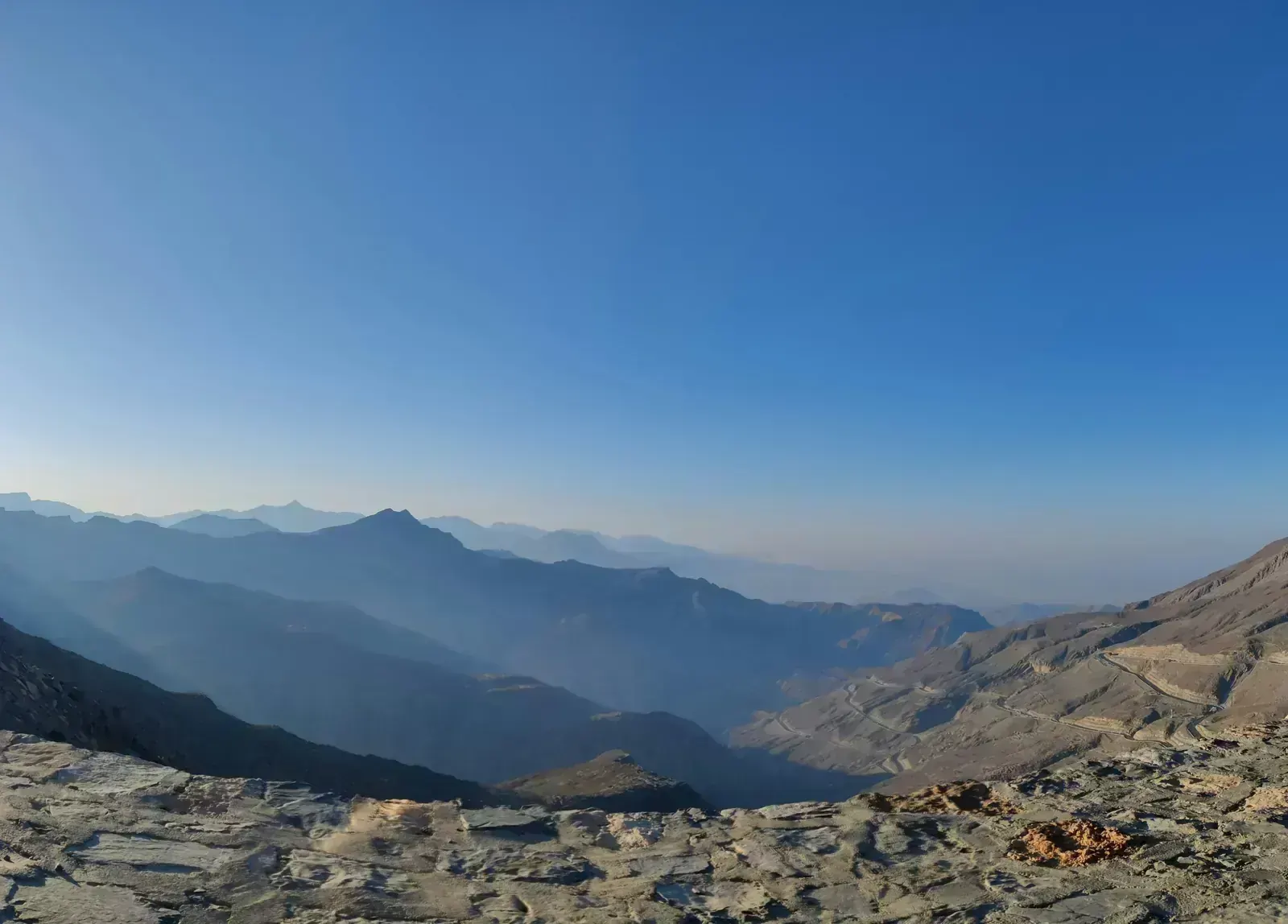
Jebel Jais rises from the coastal plain of Ras Al Khaimah to 1,934 m. The summit is in Oman's Musandam governorate; the UAE's highest point, at 1,892 m, is just west of it. A paved road of about 36 km climbs the western side in hairpins to the Jais Viewing Deck Park at about 1,250 m and the attractions of the upper mountain.
Around the road, Ras Al Khaimah has built a network of marked trails that RAKTDA puts at 94 km, with short front-country walks near the road and longer back-country routes for backpacking. An 80 km Grand Loop and a five-day via ferrata were announced in September 2026 and are not open yet. Three days on foot means one of three things: the yearly HIGHLANDER event, your own route on the marked trails with nights at the roadside camping areas, or a trip with a licensed local guide.
| Route | Days | Scenery | Crowds | Acclimatisation |
|---|---|---|---|---|
| Organised HIGHLANDER event, three days itinerary belowA yearly, self-guided group hike on a marked route with marshals, first-aid checkpoints and organised camps. The three-day format has measured 51 km (2021), 40 km (2024 and 2025) and 37 km (2026), and it changes every edition. You carry your own pack. It is not a race. | 3 | Excellent | Medium | Very good |
| Independent, marked trails and roadside campingDay walks on the marked trails, such as the Ghaf Summit trail up to about 1,640 m, linked by nights at designated camping areas along the Jebel Jais road. There is no water on the mountain, so you go back to the car or the road to resupply. For experienced hikers in a group of two or more, under 10 people. | 2–3 | Excellent | Medium | Very good |
| With a licensed local guideA private or small-group trip with a guide who holds a Ras Al Khaimah licence and can arrange vehicle support with water at road crossings. The only way to tackle the steep wadi routes, such as Wadi Ghalilah, if you don't know the mountain. Groups of 10 or more need a licensed guide and an RAKTDA permit. | 2–3 | Excellent | Low | Very good |
3-day Organised HIGHLANDER event, three days itinerary at a glance
The HIGHLANDER three-day route changes every year. The itinerary below is the one we walked at the first edition, in November 2021: about 51 km in three days, 15 km to 18 km a day with full packs. Day 1 starts low in Wadi Ghalilah and climbs steeply on the Ghaf Summit trail to an organised camp near the summit. Day 2 follows a rocky ridge with the sea on one side and cliffs on the other, then drops to a second camp beside a farm in a valley. Day 3 continues down past Wadi Haqeel to Shimal on the coast.
Because it was an event, the organisers ran water stations along the route: we each carried 5 litres and refilled on the way, which you can't do on your own. Nights were about 10 °C at the summit camp and 15 °C in the valley. Later editions reworked the route; in 2026 the three-day route started on the north face, by Wadi Latibah (the trail known as Stairway to Heaven) or Wadi Ghalilah.
- Day 1 Wadi Ghalilah Organised camp near the summit via Ghaf Summit trail 1,640 mcamp at 1,770 m
- Day 2 Organised camp beside a farm in a valley camp at 400 m
- Day 3 Shimal, on the coast camp at 50 m
What it really costs
Three days on Jebel Jais costs little in fees. The real costs are the event registration or a guide, getting to the start and back from the finish, and the camping gear. Here is what to plan around.
Insurance that covers Jebel Jais
If you live in the UAE, your local health cover may apply, but check that it includes hiking and rescue in the mountains. Visitors need a travel policy that covers hiking and medical evacuation in the UAE.
Rescues on Jebel Jais are carried out by the Ras Al Khaimah Police, sometimes by helicopter. Keep your policy number and the insurer's emergency line on your phone and on paper.
Staying connected in United Arab Emirates
The UAE's mobile networks are e& (formerly Etisalat) and du. Visitors can install a UAE eSIM before they travel or buy a tourist SIM at Dubai airport with their passport; if your home network offers roaming in the UAE, as Gulf networks do, that works too.
There is signal near the road and the upper mountain, but it can disappear entirely in deep wadis and on remote trails. Download an offline map, share your route with someone before you start and carry a whistle.
Getting there and where to stay
Fly into Dubai (DXB); Ras Al Khaimah is about 130 km north by road, one to one and a half hours. Coming from Abu Dhabi, add the drive to Dubai. The trailheads are at the foot of the mountain beyond the city, and there is no public transport to them.
Getting there by air
Dubai to Ras Al Khaimah and the trailheads
A night in Ras Al Khaimah before and after
Gear: rent or buy
This is backpacking: you carry tent, sleeping bag, food and water. The two things that matter most are water capacity and a warm enough sleeping bag. On your own, plan 4–6 litres a day, because there is no water on the mountain; on the event we carried 5 litres each and refilled at the water stations. Our November nights were about 10 °C at the summit and 15 °C in the valley, and in December to February they drop near 5 °C or lower, so bring a bag rated to about 0 °C.
- Hiking boots or trail shoes with stiff soles for scree and sharp limestoneBuy
- Backpack of 45–60 litresRent or buy
- Water bladders and bottles for 4–6 litres, plus electrolytesBuy
- Light tent that stands on rock, with extra stones or anchorsRent or buy
- Sleeping bag rated to about 0 °C and a sleeping matRent or buy
- Stove, fuel and pot (open fires and firewood collection are banned)Rent or buy
- Warm layer and windproof jacket for the eveningsBuy
- Sun hat, sunglasses and high-factor sunscreenBuy
- Headlamp, whistle, first-aid kit and power bankBuy
- Gloves for the rope-railing and scrambling sectionsRent or buy
- Trekking poles for the long descentsRent or buy
Add a few days in United Arab Emirates
The upper mountain has attractions on the road that take a few hours and need no hiking gear.
Jais Viewing Deck Park
Jais Flight
Wadi Shawka
Frequently asked questions
How hard is a three-day trek on Jebel Jais?
Harder than the altitude suggests. The organised three-day route covers 37 km to 51 km on rocky paths and scree, with long steep climbs out of the wadis and the same again on the way down, and you carry all your gear. The organiser says adults with moderate fitness can take part, with no hiking experience needed. The Stairway to Heaven route on the north face is far harder and exposed. We walked 15 km to 18 km a day with full packs: the climbs out of the wadis were the hardest part.
Do I need a permit or a guide?
No permit is needed to walk the public trails in a small group, but groups of 10 or more must register with RAKTDA in advance and need a licensed guide, and organising a hike without a permit can bring a fine of AED 10,000. Some official trailheads ask you to scan a QR code and register your start time. Stay on marked trails, never hike alone, and note that drones, alcohol and loud music are banned. The organised event has its own permits.
Can I camp anywhere on Jebel Jais?
No. Camping is allowed only in the designated areas along the Jebel Jais road, which are free but have few or no toilets, water or bins, and at paid camps such as Camp 1770. Camping outside approved places can be fined, and so can lighting open fires, collecting firewood or leaving rubbish. Never camp in a wadi bed: flash floods can arrive from rain you can't see.
Is there water on the trail?
No reliable water at all. Carry at least 3 litres for a short hike and plan 4–6 litres a day on a backpacking trip, more if it is warm. On the organised event, ask what the camps provide. On our 2021 event we each carried 5 litres and refilled at the organisers' water stations along the route.
What about food, dietary needs and faith on the trek?
Meat sold and served in the UAE is halal by default; pork is sold only in a few labelled outlets and never in camp catering. Ask the organiser or your guide what the camp meals are, and tell them when you book if you eat vegetarian or vegan, have an allergy or follow another diet. Kosher food is not something to expect at camp; bring your own if you need it.
There are mosques in the villages at the foot of the mountain. On the trek, Muslims pray at camp or on the trail: a qibla app and a light mat are enough, and organisers in the UAE are used to planning prayer stops. For any religious practice, ask the organiser or guide before you book how the day's schedule can leave time for it.
Which languages do guides speak?
Arabic is the local language, and many guides in the UAE work in both Arabic and English. Before you book, ask the organiser or guide which language the briefings and the guiding are in, and ask about other languages, such as French or Spanish, if you need one.
Should I tip?
On the organised event, ask the organiser whether tipping marshals or camp staff is usual. For a private guide, a tip at the end is common but not required; ask what is usual when you book.
Which visa do I need?
It depends on your passport: check the current rules with ICP, the UAE's Federal Authority for Identity and Citizenship, or on the government portal u.ae. Citizens of Saudi Arabia, Qatar, Kuwait, Bahrain and Oman, for example, need no visa and enter the UAE with their national ID card or passport. Expatriate residents of those countries can apply online for a 30 days UAE eVisa through ICP (AED 250 plus VAT) if their profession is on the approved list.
When is the best time to go?
November to March. Days on the mountain are 11 °C to 17 °C and nights can drop near freezing in December to February; in November 2021 we had about 10 °C at night at the summit camp and 15 °C in the valley. The HIGHLANDER three-day event takes place in winter: November in 2021 and 2022, February in 2024, 2025 and 2026. Avoid May to September, when the heat makes backpacking dangerous, and check the forecast for storms in winter.
Is it safe?
Most rescues on Jebel Jais are heatstroke, exhaustion, and falls on scree or exposed rock, and in April 2026 a hiker collapsed from heatstroke on the Stairway to Heaven route. In April 2019, flash floods stranded about 570 people on the mountain overnight. Start early, carry more water than you think, stay on marked trails, tell someone your route and return time, and leave wadis at the first sign of rain. In an emergency call 999 (police). The summit area borders Oman and there is no border post on the trails: check with your organiser before walking towards it.
Is there a rope or climbing section?
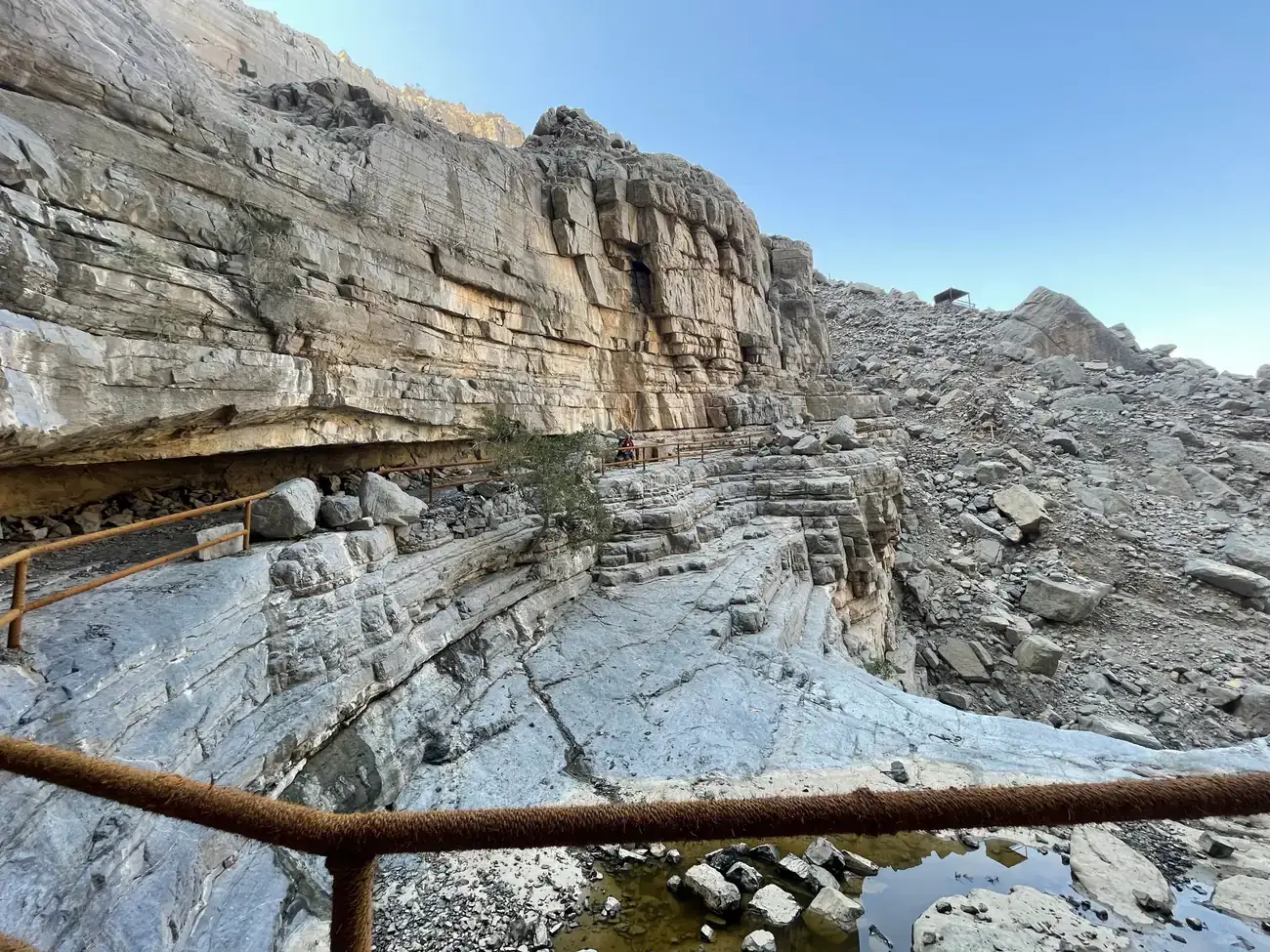
Some routes have short steep passages with fixed ropes or cables as a handrail. You don't need climbing gear, but you do need a head for heights and gloves help. On our route, a rope-wrapped metal railing guards a ledge of smooth limestone below an overhanging cliff.
Sources and last check
- RAKTDA: HIGHLANDER Ras Al Khaimah 2026 (6–8 February 2026), press release 18 December 2025
- RAKTDA: HIGHLANDER Adventure 2025 (7–9 February 2025)
- RAKTDA: HIGHLANDER returns to Ras Al Khaimah (2–4 February 2024)
- RAKTDA: Embrace nature, trail network and Wadi Shawka (November 2024)
- RAKTDA: Jebel Jais fact sheet (April 2025)
- Visit Jebel Jais: hiking, trail rules and safety
- Visit Jebel Jais: hiking trails
- Visit Jebel Jais: day-trip guide, camping areas and fines (March 2026)
- Wikipedia: Jebel Jais (altitudes, road, NCM climate data)
- u.ae: visa-free entry for GCC citizens
- Business Today: UAE eVisa for GCC residents (August 2026)
- Khaleej Times: Jebel Jais Grand Loop and via ferrata (September 2026)
- Khaleej Times: fine for organising treks in Ras Al Khaimah without a permit (2021)
- Khaleej Times: Jebel Jais flash floods of April 2019
- Gulf News: heatstroke rescue on the Stairway to Heaven trail (May 2026)
- Visit Jebel Jais: Dubai to Ras Al Khaimah by bus and taxi
Image credits
- Photo: Monica Dass / Unsplash · Unsplash License
- Photo: Pascal / HoyooTrek
- Photo: Pascal / HoyooTrek
- Photo: Dilip James / Unsplash · Unsplash License